Enterprise Simulation
ERPsim — Maple Card Game
A live ERP simulation game that puts real enterprise decision-making into practice.
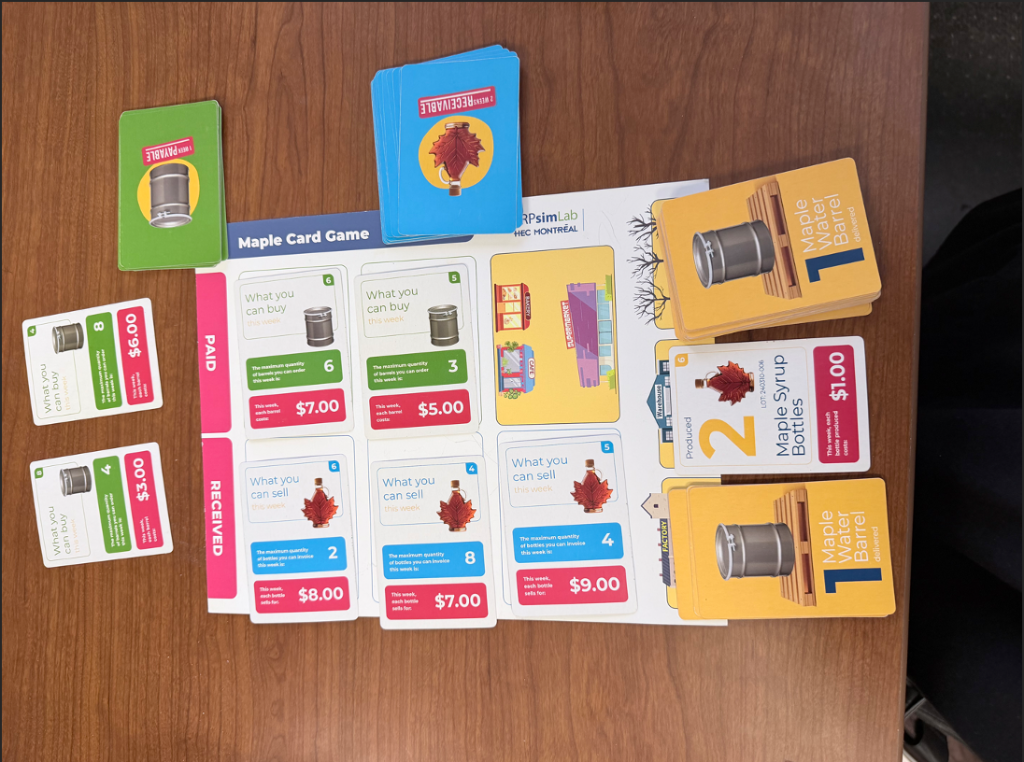
Game Decisions & Outcomes
In the ERPsim Maple Card Game, our team competed in a live ERP simulation managing a fictional maple syrup company through multiple rounds of real business decisions — pricing, production, inventory management, and distribution — all processed through an actual SAP ERP system. The simulation forced us to think in integrated systems rather than isolated functions. Every pricing decision rippled into our inventory levels; every production run had direct cash flow implications. Our team's strategy was to target the mid-market segment with competitive pricing while maintaining lean inventory to preserve working capital. Early rounds taught us that overproducing to meet assumed demand without real purchase order data was a fast path to losses. We adjusted by reading real-time ERP outputs more carefully and making smaller, more frequent production decisions rather than large batch runs. By the final rounds, our team had stabilized our margins and ranked competitively against other groups. The most valuable takeaway was understanding how ERP systems create a single source of truth — every department sees the same data in real time, which eliminates the miscommunication and lag that kills companies running on spreadsheets.
Reflection
What was the single most important business decision you made during the ERPsim game, and what would you do differently?
The single most important decision our team made was choosing to reduce our production batch sizes mid-game after seeing our inventory costs spiral in the first two rounds. We had been over-producing based on optimistic demand assumptions, and the ERP data showed us in real time that our storage costs were eating into our margins. Scaling back production and running smaller, demand-responsive batches immediately improved our financial position. If I could change one thing, it would be starting with that conservative, data-driven approach from round one instead of needing two rounds of losses to learn the lesson. In a real business context, those early losses could represent hundreds of thousands of dollars. The ERPsim made that consequence feel real in a way that a textbook case study never could.

